You ask AI to write a birthday card message. In seconds, it gives you something like this:
Wishing you a beautiful day filled with joy, laughter, love, and wonderful memories.
It’s nice. It’s polite. It’s perfectly usable. But something about it feels a little… empty.
The problem isn’t that the message is bad. The problem is that it could have been written for almost anyone.
That’s the challenge with AI-generated greeting card messages. AI can give you a helpful starting point, but it doesn’t know your relationship, your memories, your inside jokes, your family traditions, or the little details that make a card feel like it came from you.
That’s where personalization comes in.
In this guide, you’ll learn how to take an AI-generated card message and make it warmer, more natural, and more meaningful. You’ll see how to use AI the right way—not as a replacement for your heart, but as a tool to help you find the words when you’re stuck.
Whether you’re writing a birthday card, thank-you note, sympathy card, wedding message, graduation card, retirement note, or encouragement card, AI can help you begin.
But you should always add the part only you can provide.
The Problem with Most AI-Generated Card Messages
AI is very good at creating clean, polished sentences. It can write quickly. It can suggest different tones. It can make a message sound sweet, formal, funny, religious, professional, or heartfelt.
But AI has one major weakness: It doesn’t know the relationship.
- It doesn’t remember the camping trip where everything went wrong but everyone still laughed.
- It doesn’t know that your dad always says the same joke every Thanksgiving.
- It doesn’t know that your best friend orders cheesecake every time you go out.
- It doesn’t know that your grandmother’s kitchen always smelled like cinnamon rolls.
- It doesn’t know that your coworker quietly helped you through a difficult season.
Those are the details that make a greeting card memorable. AI can write a message. But only you can make it personal.
🌿 Evergreen Tip
AI can help you find the words.
But your memories, your relationship, and your voice are what make those words matter.
The Biggest Myth About Using AI for Greeting Cards
Some people feel guilty using AI to write a card message. They wonder if it’s cheating. They worry the message won’t be sincere.
They think a “real” card message has to be written completely from scratch. But that’s not really how people have ever written greeting cards.
For years, people have looked at:
- Printed messages inside store-bought cards
- Greeting card websites
- Message idea books
- Bible verses
- Quotes
- Examples from friends or family
AI is simply another source of inspiration. The question isn’t whether you used help. The question is what you did with it afterward.
If you copy an AI message exactly as written, it may sound generic. But if you revise it, personalize it, and add your own details, it can become a thoughtful message that truly fits the recipient.
The 80/20 Rule for AI Card Messages
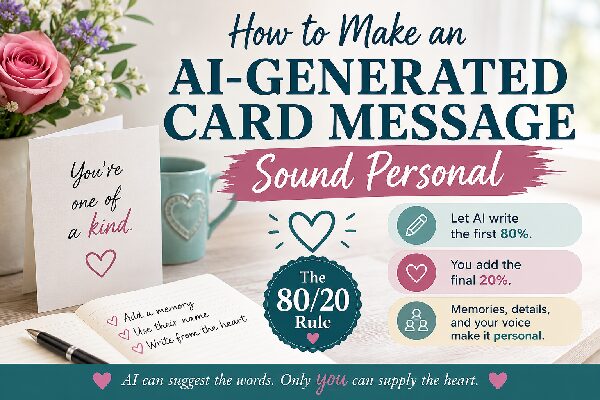
The easiest way to make an AI-generated card message sound personal is to use what I call the 80/20 Rule.
Let AI help with the first 80%. Then you add the final 20%. That final 20% is where the heart lives.
AI can help with:
- Basic wording
- Message structure
- Tone
- Occasion-specific phrases
- Shorter or longer versions
- Ideas when you feel stuck
But you should add:
- The person’s name
- A shared memory
- A specific compliment
- An inside joke
- A detail about your relationship
- A natural closing
- Your real voice
That last 20% transforms the message from something AI wrote into something you wrote with help.
🌿 Evergreen Tip
Let AI write the draft.
You write the heart.
That final personal touch is what makes the card feel real.
Why the Last 20% Matters Most
Imagine two people receive the same AI-generated birthday message.
Generic AI Message
Happy Birthday! Wishing you a wonderful day filled with love, laughter, and all the happiness you deserve.
That’s nice. But now look what happens when the writer adds the final 20%.
Personalized Version
Happy Birthday, Aunt Linda! Wishing you a wonderful day filled with love, laughter, and all the happiness you deserve. I still think about those summer afternoons on your porch, drinking sweet tea and listening to your stories. You’ve always made everyone feel welcome, and I hope today reminds you how loved you are.
The first message is pleasant. The second message belongs to Aunt Linda. That’s the difference.
What AI Can Do Well
AI can be especially helpful when you’re stuck at the beginning.
It can help you:
- Find a gentle opening
- Choose the right tone
- Shorten a message that’s too long
- Make a message warmer
- Make a message more professional
- Rewrite awkward wording
- Generate several options
- Give you examples for different occasions
For example, you might ask AI:
Write a short birthday message for my sister that is warm but not too emotional.
Or:
Write a sympathy card message that is simple, sincere, and not overly religious.
Or:
Make this thank-you note sound more natural and less formal.
Used this way, AI can remove the blank-page pressure. It gives you something to react to. And sometimes that’s all you need.
What AI Cannot Do for You
AI cannot know what matters between you and the recipient unless you tell it.
It cannot know:
- What memories you share
- What the person has been through
- What kind of humor they enjoy
- Whether they prefer sentimental or simple messages
- What words sound natural coming from you
- What details would make them smile
- What might accidentally feel too formal, too casual, or too emotional
That’s why even a beautifully written AI message may still feel slightly off. It may be polished, but not personal. It may be correct, but not connected.
✨ Before & After: Birthday Card
AI Version
Happy Birthday! I hope your day is filled with joy, laughter, and everything that makes you happiest.
Personalized Version
Happy Birthday, Megan! I hope your day is filled with joy, laughter, and everything that makes you happiest—including cake for breakfast if you decide to continue our old tradition. I’m so thankful for all the memories we’ve made and all the ones still ahead.
The original message was fine. The personalized version includes:
- The recipient’s name
- A shared tradition
- A relationship detail
- A warmer closing thought
That is the 80/20 Rule in action.
✨ Before & After: Thank-You Card
AI Version
Thank you for your thoughtful gift. I truly appreciate your kindness and generosity.
Personalized Version
Thank you so much for the beautiful journal. You remembered how much I’ve been trying to write more this year, and that made your gift even more thoughtful. I truly appreciate your kindness.
The AI version says thank you. The personalized version explains why the gift mattered.
✨ Before & After: Encouragement Card
AI Version
Stay strong during this difficult time. You are capable of overcoming this challenge.
Personalized Version
I know this season has been heavy, and I won’t pretend it’s easy. But I also know how steady and brave you’ve been, even on the hard days. I’m here whenever you need someone to listen, pray, or simply sit with you.
The personalized version sounds less like a slogan and more like support from a real person.
The AI Sandwich Method
Another easy way to personalize an AI-generated card message is to use the AI Sandwich Method.
Here’s how it works:
- Start with your own opening.
- Use the AI message as the middle.
- Add your own personal detail.
- Finish with your own closing.
Think of the AI message as the filling. Your relationship goes around it.
Example
AI Draft
Wishing you a birthday filled with happiness, laughter, and wonderful memories.
AI Sandwich Version
Happy Birthday, Sarah!
Wishing you a birthday filled with happiness, laughter, and wonderful memories.
I still laugh about the time we got caught in the rain at the state fair and ended up eating funnel cake in the car.
Love you always.
Now the message sounds like it came from a person, not a program.
Part 1 Summary
AI can be a wonderful tool for writing greeting card messages, especially when you don’t know where to begin. But AI should not have the final word.
Use it for inspiration. Use it for structure. Use it to get unstuck. Then add the part only you can give:
- The name
- The memory
- The relationship
- The warmth
- The voice
- The heart
That’s how an AI-generated message becomes personal.
🌿 Evergreen Summary
AI can write a polished message. But polished is not the same as personal.
Use the 80/20 Rule:
Let AI help with the first 80%. Then add the final 20% yourself.
That last 20% is where the real message begins.
Coming Up in Part 2
In Part 2, we’ll look at how to personalize AI-generated messages for specific occasions, including birthday cards, thank-you notes, sympathy cards, encouragement cards, wedding cards, graduation cards, retirement cards, and new baby cards.
Using AI for Birthday Card Messages
Birthday cards are one of the best places to use AI because the tone can vary so much.
Maybe you want something funny. Maybe sentimental. Maybe short. Maybe heartfelt.
AI can generate all of those styles in seconds. The trick is not accepting the first draft.
Instead, ask yourself:
- Does this sound like me?
- Does it mention anything unique about the birthday person?
- Would someone else be able to receive this exact same message?
If the answer to the last question is yes… Keep editing.
✨ AI Draft
Happy Birthday! Wishing you a year filled with happiness, laughter, success, and countless blessings.
Perfectly nice. Perfectly generic.
✨ Personalized Version
Happy Birthday, Ben! I hope this year brings you as much happiness as you’ve brought everyone around you. I still laugh whenever I think about our fishing trip when we somehow caught everything except fish. Here’s to another year of great memories together.
Notice what changed? The AI created the structure. You added the relationship.
🌿 Evergreen Tip
Birthdays are about celebrating the person—not the calendar.
AI can celebrate the birthday. Only you can celebrate the person.
Using AI for Thank-You Cards
Thank-you cards become memorable when you explain why someone’s kindness mattered.
AI usually thanks the person. You should explain the impact.
✨ AI Draft
Thank you so much for your thoughtful gift. Your generosity is greatly appreciated.
✨ Personalized Version
Thank you so much for the bird feeder. Every morning I’ve been sitting by the kitchen window with my coffee watching the cardinals and finches stop by. It’s already become one of my favorite parts of the day, and I’ll think of you every time I see them.
Instead of simply saying thank you…
Tell the story.
Using AI for Sympathy Cards
Sympathy is where personalization matters most. AI can produce kind, compassionate wording. But it doesn’t know the person who passed away. It doesn’t know what made them special.
One memory can completely transform the message.
✨ AI Draft
I’m deeply sorry for your loss. Wishing you peace and comfort during this difficult time.
✨ Personalized Version
I’m so sorry for your loss. I’ll always remember your dad’s warm smile and the way he could make an entire room laugh within minutes. I hope those wonderful memories bring you comfort in the difficult days ahead.
The AI supplied compassion. You supplied remembrance. That’s the difference.
🚫 Common Mistake
Don’t ask AI to write something “profound.” Profound usually sounds impersonal.
Instead ask for something:
- simple
- gentle
- sincere
- hopeful
- compassionate
Simple almost always feels more authentic.
Using AI for Encouragement Cards
Encouragement cards should sound like they’re coming from a friend… not a motivational poster.
AI often leans toward inspirational clichés. Your job is to replace those with genuine support.
✨ AI Draft
Never give up because brighter days are ahead and everything happens for a reason.
✨ Personalized Version
I know this season has been incredibly difficult, and I won’t pretend it’s easy. I simply wanted to remind you that you’re not carrying it alone. I’m praying for you, and I’m always just a phone call away.
The second message doesn’t promise easy answers. It promises presence. That’s usually far more encouraging.
🌿 Evergreen Tip
People rarely need perfect advice.
They usually need to know someone cares enough to reach out.
Using AI for Wedding Cards
Wedding cards naturally lend themselves to AI because the basic structure is similar from couple to couple. Where personalization comes in is describing the relationship you’ve observed.
✨ AI Draft
Congratulations on your wedding! Wishing you many years of love and happiness together.
✨ Personalized Version
Congratulations on your wedding! Watching the two of you encourage each other, laugh together, and genuinely enjoy one another has been a joy. May your marriage continue to grow stronger with every passing year.
Now the message feels like it was written by someone who actually knows the couple.
Using AI for Graduation Cards
Graduation cards become much stronger when you acknowledge effort instead of simply celebrating achievement.
AI usually congratulates. You should recognize the journey.
✨ AI Draft
Congratulations on your graduation! Wishing you success in all your future endeavors.
✨ Personalized Version
Congratulations, Emma! I’ve watched how hard you’ve worked over the last four years, even when classes felt overwhelming. You earned every bit of this celebration, and I can’t wait to see where your determination takes you next.
Specific effort. Specific encouragement. Specific future.
Using AI for Retirement Cards
Retirement cards often become keepsakes. Mention something the retiree will be remembered for.
AI can’t know that. You can.
✨ AI Draft
Congratulations on your retirement. Wishing you happiness and relaxation in the years ahead.
✨ Personalized Version
Congratulations on your retirement! The office won’t be the same without your encouragement, steady leadership, and your famous Friday morning doughnuts. Wishing you many happy mornings without alarm clocks and plenty of new adventures.
Small details… Big difference.
Using AI for New Baby Cards
New baby cards should feel joyful. AI is usually pretty good at that. All you need to add is warmth.
✨ AI Draft
Congratulations on the arrival of your beautiful baby. Wishing your family every happiness.
✨ Personalized Version
Congratulations on your beautiful baby girl! I already know she’s going to be surrounded by so much love. Wishing your family countless sweet moments, sleepy snuggles, and memories you’ll treasure forever.
Using AI for Christmas and Holiday Cards
Holiday cards are usually short. Don’t overcomplicate them. AI works best when you simply make the greeting sound like your own voice.
AI Draft
Wishing you peace, joy, and happiness this holiday season.
Personalized Version
Merry Christmas, Tom and Linda! Hope your home is filled with laughter, good food, and lots of family time this Christmas. Looking forward to seeing you both in the New Year!
The Five Things AI Can Never Know
No matter how advanced AI becomes, there are five things it can never truly know unless you tell it.
- Your shared memories.
- Your inside jokes.
- Your family traditions.
- Your private nicknames.
- Your authentic voice.
Those five things are what make a greeting card sound human. Not perfect. Human.
🌿 Evergreen Tip
If your AI-generated message includes even one memory that belongs only to your relationship…
It immediately becomes something AI could never have written by itself.
Part 2 Summary
AI can write birthday messages. AI can write thank-you notes. AI can write sympathy cards. AI can even write retirement speeches.
But every one of those messages becomes better when you add something only you know. A shared laugh. A favorite memory.
A compliment you’ve been meaning to say. A simple reminder that this isn’t just another greeting card. It’s their greeting card.
Coming Up in Part 3
In Part 3, you’ll learn:
- How to prompt AI for better first drafts.
- The easiest way to rewrite robotic wording.
- Ten common AI mistakes to avoid.
- Fill-in-the-blank personalization templates.
- Frequently asked questions about using AI to write greeting card messages.
- The final checklist I use before signing every AI-assisted greeting card.
How to Get Better AI Greeting Card Messages
One of the biggest reasons AI-generated greeting card messages sound generic has nothing to do with AI. It has to do with the prompt.
If you ask:
“Write a birthday card.”
You’ll probably get a birthday card that could be sent to almost anyone.
But if you ask:
“Write a warm birthday message for my older sister who loves gardening, has an amazing sense of humor, and always hosts Thanksgiving dinner. Keep it conversational and about 50 words.”
The result immediately becomes better.
The more helpful information you give AI, the more helpful the first draft becomes.
✨ Better Prompt Formula
Tell AI:
- Who the message is for.
- The occasion.
- Your relationship.
- The tone you want.
- About how long it should be.
- One or two details about the recipient.
Example Prompt
Write a heartfelt retirement card for my coworker. She’s worked here for 28 years, loves gardening, and is known for bringing homemade cookies every Friday. Keep it around 75 words and make it sound warm but conversational.
Notice how much easier that is than starting from a blank page. AI isn’t reading your mind. It’s following your directions.
🌿 Evergreen Tip
Better prompts create better first drafts.
The more context you provide, the less editing you’ll need later.
How to Rewrite Robotic AI Wording
Even good AI writing sometimes sounds…well…like AI.
Certain words and phrases appear over and over again.
For example:
- May your day be filled with…
- Wishing you endless joy…
- Countless blessings…
- On this special occasion…
- Heartfelt congratulations…
- Best wishes for continued success…
None of those phrases are wrong. They’re simply overused. Instead of asking whether a sentence sounds beautiful, ask yourself:
“Would I actually say this to this person?”
If the answer is no, rewrite it.
✨ Before & After
AI Version
May your special day be filled with immeasurable happiness and abundant blessings.
Natural Version
Hope your birthday is filled with good food, lots of laughter, and the people you love most.
The second version feels more like a real conversation. That’s almost always the better choice.
The Five Most Common AI Mistakes
Even the best AI tools make predictable mistakes. Knowing what to watch for will help you improve every greeting card.
1. Too Generic
If the message could be sent to anyone, it isn’t personal enough. Add one memory. One compliment. One detail.
2. Too Formal
Most people don’t talk like greeting card companies. Use everyday language. Write the way you naturally speak.
3. Too Repetitive
AI sometimes repeats the same idea several different ways. Remove duplicate thoughts. Keep the strongest sentence.
4. Too Perfect
Real people aren’t perfectly polished. It’s okay if your message sounds human. In fact…that’s the goal.
5. No Personal Connection
This is the biggest one. AI doesn’t know your relationship. You do. Always add something that belongs only to the two of you.
🚫 Common Mistake
Don’t judge your greeting card by how impressive it sounds. Judge it by whether the recipient feels like you wrote it.
The One Memory Rule
If you remember only one editing tip from this guide, remember this one.
Add one memory.
It doesn’t have to be dramatic. It could be:
- A family vacation.
- A favorite restaurant.
- A funny mistake.
- A shared hobby.
- A holiday tradition.
- A conversation you’ll never forget.
- The way they helped you during a difficult season.
- A nickname only the two of you use.
One memory instantly transforms an AI-generated message into something personal.
✨ Before & After
AI Draft
Thank you for always being such a wonderful friend.
Personalized Version
Thank you for always being such a wonderful friend. I’ll never forget those Saturday mornings when we’d spend hours talking over coffee while everyone else in the café wondered why we were still there.
One memory. One sentence. Completely different message.
Fill-in-the-Blank AI Personalization Templates
These templates work with almost any AI-generated greeting card.
Template 1
One thing I’ve always appreciated about you is __________________.
Template 2
I’ll never forget the time we __________________.
Template 3
Every time I think about __________________, I smile.
Template 4
You have a gift for __________________.
Template 5
I’m grateful for the way you always __________________.
Adding just one of these sentences can make almost any AI draft sound like it came from you.
The Final AI Editing Checklist
Before writing your message inside the card, ask yourself:
- Did I add the person’s name?
- Did I remove robotic wording?
- Did I include one personal detail?
- Does this sound like something I would actually say?
- Would someone else be able to receive this exact same message?
- Does the message fit our relationship?
- Did I add warmth?
- Did I sign it naturally?
If you answered “yes” to all of those questions, your AI-assisted greeting card is ready.
Frequently Asked Questions
Is it wrong to use AI to write greeting cards?
Not at all. Think of AI as a writing assistant rather than a replacement for your own thoughts. It’s no different than using greeting card message ideas, books, or online examples for inspiration.
Will people know I used AI?
If you copy and paste the message without editing it, they might notice it sounds generic. If you personalize it with your own memories, tone, and voice, they’ll simply feel like you wrote a thoughtful card.
Should I tell someone I used AI?
That’s entirely up to you. Most people don’t announce that they used a dictionary, a greeting card, or a message book either. The important thing is that the final message genuinely reflects your feelings.
Can AI write sympathy cards?
Yes. But sympathy cards should always be reviewed carefully. Keep them simple. Remove clichés. Add one sincere memory if appropriate.
Can I use AI for business greeting cards?
Absolutely. AI is especially helpful for professional cards because it can create polished wording while you add a personal touch.
What’s the best way to personalize an AI message?
Add one shared memory. It’s the quickest way to make the message sound human.
Can I combine AI with the Greeting Card Message Generator?
Definitely. Many people find it helpful to generate ideas from several places before creating their own final version.
How much should I change?
There’s no rule. Sometimes changing one sentence is enough. Other times you may rewrite most of the draft. Use whatever helps the message sound like you.
Can AI help me write better?
Yes. Many people find that reading AI suggestions improves their own writing over time because it gives them new ways to express familiar thoughts.
What’s the one thing AI can never replace?
Your relationship with the recipient. That’s what makes every meaningful greeting card unique.
Related Card Writing Guides
Continue improving your greeting card writing skills with these helpful guides.
- How to Write a Meaningful Greeting Card Message
- How to Personalize a Greeting Card Message
- What to Write in a Card When You Don’t Know What to Say
- How Long Should a Greeting Card Message Be?
- Greeting Card Etiquette (Coming Soon)
Need Inspiration?
Need help getting started?
Try our Free Greeting Card Message Generator to generate ideas, then use the techniques in this guide to make every message sound like it came from you.
You can also browse our growing Greeting Card Message Library for hundreds of examples organized by occasion and relationship.
Final Thoughts
Artificial intelligence is changing the way people write. It can save time. It can reduce writer’s block. It can suggest better wording. It can help you find the right tone.
Those are wonderful tools. But tools don’t build relationships. People do.
The greeting card someone keeps for years won’t be the one with the most polished sentences. It will be the one that reminds them of a shared laugh…
A favorite memory…
A difficult season you walked through together…
Or simply the feeling that someone truly knew them.
That’s something AI can never create on its own.
It needs you.
So don’t be afraid to use AI. Just don’t stop there. Use it to begin. Then add your voice. Your memories. Your personality. Your heart.
Because that’s the final 20%… and it’s the part they’ll remember.
🌿 Evergreen Summary
Remember the 80/20 Rule. Let AI help with the first 80%. You provide the final 20%.
The names.
The memories.
The laughter.
The gratitude.
The love.AI can write beautiful sentences. Only you can make them personal. That’s the difference between a message someone reads… and one they keep forever.